
Obstetric 3D simulation training system + MR solution
VR and MR · Smart Maternal & Infant Care — A leading and efficient obstetric emergency training and simulation solution.
System Overview & Core Vision
Built upon the profound clinical expertise of the Obstetrics and Gynecology Hospital of Fudan University, the Obstetric 3D simulation training system integrates a PC-based virtual simulation platform with a Mixed Reality (MR) platform. It is designed to establish a world-leading obstetric emergency training base, realizing the vision of an always-accessible clinical practice arena.
Pinpointing Clinical Pain Points
Addressing industry challenges in training for critical obstetric emergencies—such as eclampsia, amniotic fluid embolism, and postpartum hemorrhage—where rare cases, high operational risks, and the inability to repeat drills are common, this system provides a zero-risk, standardized training environment. It eliminates fluctuations in training quality caused by varying levels of instructor expertise.
Dual-Platform Technical Architecture
PC Version: Supports large-scale basic clinical reasoning training and standardized examinations for students, running smoothly on Windows systems equipped.
MR Version: Based on Microsoft HoloLens 2, it achieves spatial integration of virtual and real environments along with multi-user collaborative hands-on practice, while preserving a natural feel for hand manipulation.
Deeply Anchored Value Proposition
More than just a software tool, it serves as an always-accessible clinical practice arena built for every medical trainee. It ensures that doctors have profound practical confidence before working independently, and supports continuous professional growth throughout their entire career journey—from medical students to senior physicians.
Dual-Platform Integrated Solution
The system features a pioneering dual-track mechanism integrating PC virtual simulation and Mixed Reality (MR). The PC version focuses on large-scale basic clinical reasoning training and standardized assessments, while the MR version specializes in spatial integration of virtual and real environments as well as team collaborative practice. With seamless data interoperability between the two platforms, it creates a comprehensive training loop—from individual skills to team coordination—maximizing training outcomes.
PC-Based 3D Virtual Training
MR Mixed Reality Training
System Configuration and Deployment Environment
The system features a lightweight client architecture that runs on Windows 7 or later with a mid-tier graphics card. The client is only 2GB in size and supports one-click installation and custom path deployment. It eliminates the need for expensive server clusters, significantly reducing hardware investments and IT maintenance costs for medical institutions, while remaining compatible with mainstream medical office equipment.
Lightweight Deployment
The client installer is only 2GB in size and supports one-click download and installation with a customizable installation path. It also creates a desktop shortcut, requiring no professional technical background throughout the entire process.
Security & Compatibility
Compatible with Windows 7 through Windows 11, it enables highly efficient and rapid large-scale online drills.
Offline Access
Supports offline access to the case library and local data storage, ensuring data security within hospital intranet environments and enabling training without the need for a continuous internet connection.
Automatic Updates
Features a built-in automatic update mechanism to ensure the continuous iteration of the case library. It supports cloud-based data storage and the synchronization of trainee scores across multiple hospital campuses.
Hardware Requirements
|
Component |
Minimum Requirements |
Recommended Requirements |
|
Operating System |
Windows 7 |
Windows 10/11 |
|
Processor |
Intel Core i5-3470 / AMD FX8310 |
Intel Core i7 or above |
|
Graphics Card |
Dedicated GPU such as Nvidia GTX 1650 / ATI HD 6990 |
Nvidia RTX 2060 or above |
|
Memory |
4GB RAM |
8GB RAM or above |
|
Storage |
2GB available space |
SSD (Solid State Drive) |
|
DirectX |
Version 11 |
Version 11 or higher |
System Configuration and Deployment Environment
The system features a lightweight client architecture that runs smoothly on Windows 7 or later with a mid-tier graphics card. The client is only 2GB in size and supports one-click installation with a customizable deployment path. It eliminates the need for expensive server clusters, significantly reducing hardware investments and IT maintenance costs for medical institutions, while remaining fully compatible with mainstream medical office equipment.
Technical Architecture Innovation
Mind Map-Driven Flexible Drill Model
Utilizing actual surgical procedure scripts and data models, combined with feature attention mechanisms and uncertainty calibration, it achieves intelligent simulation of disease progression, ensuring high fidelity and clinical relevance of the training scenarios.
Unlimited Scalability
Parametric Modeling and Modular Combination
Through parametric modeling and modular action definitions, it supports the free combination of 24 action nodes—including hand scrubbing, surgical draping, ultrasound examination, order entry, surgical incision, CPR, and electrical defibrillation—breaking through the bottleneck of fixed case numbers in traditional software.
Deep Customization Capabilities
One-Click Import and Personalized Configuration
Administrators can import newly arranged mind map cases with a single click and customize clinical workflows, exam checkpoints, and grading criteria. This ensures that the training content continuously evolves in sync with each hospital's actual clinical guidelines, meeting personalized teaching requirements.
High-Fidelity Simulated Operating Room and Multi-Role Collaboration
The virtual operating room is equipped with core equipment, including a dedicated surgical table, professional surgical lights, ventilators, anesthesia machines, sterile scrub sinks, and vital signs monitors. It replicates the spatial layout and equipment interaction logic of a real operating room at a 1:1 scale. Supporting multi-role collaboration across five specialized positions, trainees can freely switch between any roles according to their training needs, enabling them to comprehensively master emergency rescue coordination workflows.
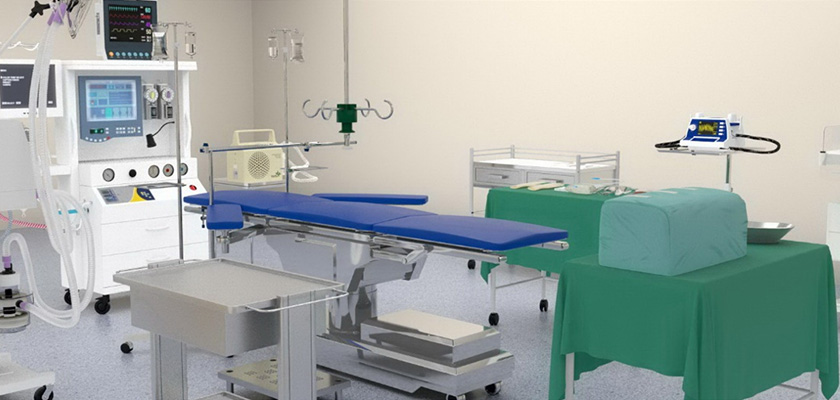
Comprehensive Equipment Configuration
Equipped with core equipment such as a dedicated surgical table, professional surgical lights, ventilators, anesthesia machines, sterile scrub sinks, and vital signs monitors. All equipment operations strictly adhere to clinical standards, supporting refined operational training in areas such as ultrasound examinations, ECG data interpretation, and anesthesia machine parameter adjustments.
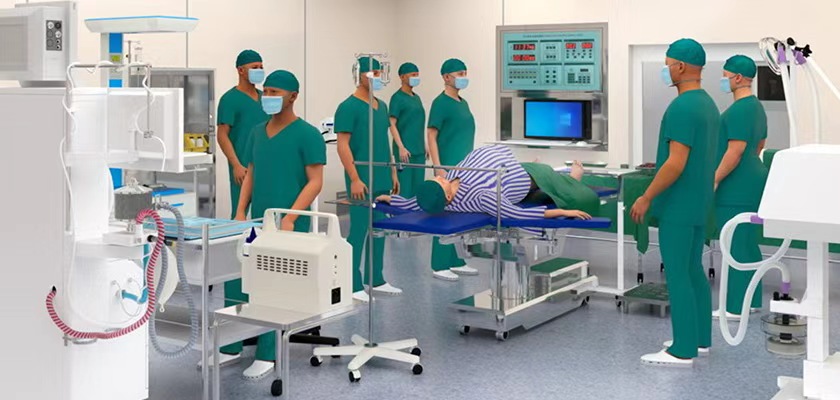
Collaboration Across Five Specialized Roles
The attending/chief physician oversees the overall situation and issues medical orders, the resident physician performs procedures and provides vital sign feedback, and the scrub/circulating nurses manage instruments and provide peripheral support. Trainees can freely switch between any of these roles to master emergency rescue collaboration workflows.
MR Mixed Reality: Immersive Team Training
Built on the Microsoft HoloLens 2, this MR platform seamlessly overlays virtual patients onto the physical environment. It supports collaborative interaction for five users within the same virtual space while preserving natural hand operations. It is a pioneer in offering immersive team emergency rescue training for two critical conditions: postpartum hemorrhage and eclampsia seizures.
Cutting-Edge Hardware Configuration
Equipped with five Microsoft HoloLens 2 headsets that support spatial tracking and gesture recognition, this system allows trainees to view highly realistic virtual patients and medical equipment within their actual physical environment, effectively eliminating the dizziness and sense of isolation commonly associated with VR.
Mixed Interaction Advantages
It preserves real-world environmental awareness and natural hand manipulation, enabling risk-free clinical decision-making drills. Through blended reality technology, trainees can interact with virtual patients in their actual physical environment, significantly enhancing skill transfer.
Dual-Mode Training Mechanism
It provides a guided training mode (featuring operational prompts and knowledge explanations) and a prompt-free examination mode (creating a zero-prompt pressure scenario). This caters to the complete learning cycle from study to assessment, maximizing training effectiveness.
Three Core Functional Modules
The system builds a comprehensive training loop integrating simulation training, video learning, and theoretical assessment. The interconnected data across these three modules generates complete learning profiles and tracks the progression of trainees' competencies.
Case Simulation Training
It offers both training and examination modes: the training mode includes operational prompts and knowledge explanations, while the examination mode simulates real clinical pressure. It covers the complete clinical workflow, including medical history taking, physical examinations, interpretation of auxiliary tests, medical order entry, and emergency interventions.
Video Learning Resources
It features a standardized video library covering common obstetric procedures and emergency management workflows, with keyword search support. The videos are deeply integrated with case scenarios, allowing trainees to instantly access relevant procedural demonstrations during simulation training.
Online Assessment
It supports three levels of difficulty (Basic, Advanced, and Expert) and covers various question types, including single-choice, multiple-choice, and case analysis. Assessment results are provided in real-time, with incorrect answers automatically categorized into knowledge gap analyses to guide future learning priorities.
15 Mature Clinical Case Resource Systems
The case library covers 15 types of critical and emergency obstetric conditions, including postpartum hemorrhage, amniotic fluid embolism, eclampsia seizures, and uterine rupture. These cases are organized into four categories: critical obstetric emergencies, complex pregnancy management, shock and resuscitation, and gynecological training, ensuring high fidelity and clinical relevance in all training scenarios.
Core Mature Case Classification List
| Category | Case Name | Core Training Focus |
| Critical Obstetric Emergencies | Postpartum Hemorrhage, Acute Heart Failure, Amniotic Fluid Embolism, Eclampsia Seizures, Uterine Rupture | Timeliness of emergency response, MDT team collaboration, standardized medication protocols |
| Complex Pregnancy Management | Placenta Accreta Spectrum, Acute Fatty Liver of Pregnancy, Placental Abruption, Umbilical Cord Prolapse, Disseminated Intravascular Coagulation (DIC) | Perioperative risk assessment, multidisciplinary joint diagnosis and treatment decision-making |
| Shock and Resuscitation | Critical Resuscitation for Hemorrhagic Shock, Pregnancy Complicated by Acute Respiratory Distress Syndrome, HELLP Syndrome, Acute Fetal Intrauterine Distress | Life support techniques, correction of internal environment disorders, assessment of resuscitation timing |
| Gynecological Training | Hysteroscopic Surgery | Standardization of surgical procedures, early identification and management of complications |
The 15 cases cover risk scenarios across the entire continuum of care from prenatal to postpartum periods, meeting diverse training needs.
Specialized Breakthrough in Obstetric "Acute, Difficult, and Critical" Cases
The system features specialized, in-depth development targeting life-threatening obstetric conditions such as postpartum hemorrhage, amniotic fluid embolism, and eclampsia seizures. It simulates critical scenarios including dynamic monitoring of blood loss, multidisciplinary emergency response, and specialized medication dosage determination. This bridges the training gap caused by the rarity of such cases in clinical clerkships, ensuring that trainees are fully prepared and confident when facing these critical emergencies in real-world practice.
Management of Postpartum Hemorrhage
Covers key techniques such as volume resuscitation, blood transfusion protocols, blood crossmatching requests, and B-Lynch suturing. It simulates dynamic blood loss monitoring and stepwise hemostatic strategies, training trainees to identify and manage multiple etiologies, including uterine atony, genital tract trauma, and coagulopathy.
Management of Amniotic Fluid Embolism
Simulates the onset of rare but highly critical emergencies, focusing on multidisciplinary emergency response mechanisms. It drills the joint rescue workflows and decision-making timelines involving anesthesia, ICU, and obstetrics, while training life-support techniques such as cardiopulmonary resuscitation (CPR) and emergency surgical interventions.
Management of Eclamptic Seizures
Strengthens the proficiency in determining dosages, timing of administration, and toxicity monitoring for specialized medications such as magnesium sulfate. It simulates the progression of hypertensive emergencies during pregnancy, covers the identification and management of HELLP syndrome, and enhances perioperative risk assessment capabilities.
Training Mode Operation Workflow
The system is designed around clinical reasoning pathways, featuring a five-step operation workflow: case selection → background learning → immersive operation → medical order entry → scoring and feedback. The progression of the patient's condition is driven by narrative dialogues. The intelligent scoring algorithm employs an exact matching mechanism, requiring medical orders to be completely consistent with the standard protocols across dimensions such as medication type, dosage, and route of administration.
01. Case Selection Stage
Select a target case from the categorized case library. It supports filtering by difficulty level (Basic, Advanced, Expert), disease type, and training objectives, covering 15 types of critical and emergency obstetric conditions.
02. Background Learning Stage
The system displays key case knowledge, a brief medical history, and initial examination results. It supports a skip function to quickly enter the operation phase, allowing trainees to start the simulation directly once they are familiar with the medical history.
03. Immersive Operation Stage
The progression of the patient's condition is driven by narrative dialogues. Trainees are required to select the correct actions at each assessment checkpoint. The top of the interface displays the case name and elapsed time in real time, while the right side records an operational timeline.
04. Medical Order Entry Stage
Users enter a professional medical order interface that strictly adheres to clinical standards. The interface is categorized into five main sections: medications, blood products, nursing care, laboratory tests, and medical instructions. It supports dosage adjustments and combined order entry.
05. Scoring and Feedback Stage
The system automatically generates a quantitative score, detailing the deductions and providing explanations for the correct answers. It supports repeated training sessions, and all scores are automatically archived in the historical records.
Examination Mode and Assessment System
This module simulates a zero-prompt, high-pressure scenario in a real clinical environment, requiring trainees to independently complete medical history taking, diagnostic reasoning, and treatment plan formulation. It generates standardized, traceable evidence for competency certification.
Zero-Prompt High-Pressure Environment
Simulates real clinical decision-making pressure by hiding operational prompts and knowledge explanations. It requires trainees to independently complete diagnosis and management based on their own knowledge base, thereby assessing their true clinical adaptability.
Intelligent Timer and Path Screen Recording
Records the response time at each decision node to identify hesitation and decisiveness in decision-making. It captures the entire operational path and decision-making process, supporting playback to review the trainee's thought process and facilitating targeted guidance from instructors.
Exact Match Scoring Mechanism
Requires medical orders to be completely consistent with the standard protocols across dimensions such as medication type, dosage, and route of administration. This reinforces awareness of clinical guidelines, trains precision in medication administration, and cultivates rigorous clinical reasoning.
Archive Management and Report Export
Scores are automatically archived, supporting multi-dimensional retrieval by time period, case type, and assessment results. The system generates PDF training reports to meet the documentation requirements of hospitals for the evaluation and certification of medical trainees.
Intelligent Medical Order System and Exact Match Scoring
The system features a high-fidelity medical order entry module that strictly adheres to clinical standards, categorized into five major groups: medications, blood products, nursing care, laboratory tests, and special instructions. The scoring algorithm employs an exact match mechanism, requiring medical orders to align perfectly with standard protocols across dimensions such as medication type, dosage, and route of administration.
Medication Orders
Covers commonly used obstetric medications such as oxytocin, magnesium sulfate, and sedatives. It supports dosage modifications and administration frequency settings, simulating the selection of hemostatic agents and volume resuscitation medications for massive hemorrhage scenarios.
Blood Products and Laboratory Test Orders
Includes transfusion orders for red blood cells, plasma, and platelets, simulating the blood transfusion workflow and crossmatching requests in massive hemorrhage scenarios. It also covers essential emergency laboratory tests such as complete blood count (CBC), coagulation profile, liver and renal function panels, and blood gas analysis.
Nursing and Medical Instruction Orders
Covers basic nursing measures such as position management, oxygen therapy, electrocardiographic monitoring, and fasting (NPO). It also includes medical instructions for informed consent for surgical procedures and patient condition disclosure, ensuring comprehensive coverage of the entire diagnosis and treatment workflow.
Learning Archives and Data Tracking System
The system automatically generates a personal learning profile, recording complete operation logs for all training sessions. It supports filtering and querying by case type, time range, and score interval. A visual score trend chart displays the progression of competency across multiple training sessions for the same case, helping to identify knowledge gaps and operational errors, while automatically generating personalized review recommendations.
Trainee Competency Improvement Trend (Amniotic Fluid Embolism Case Example)
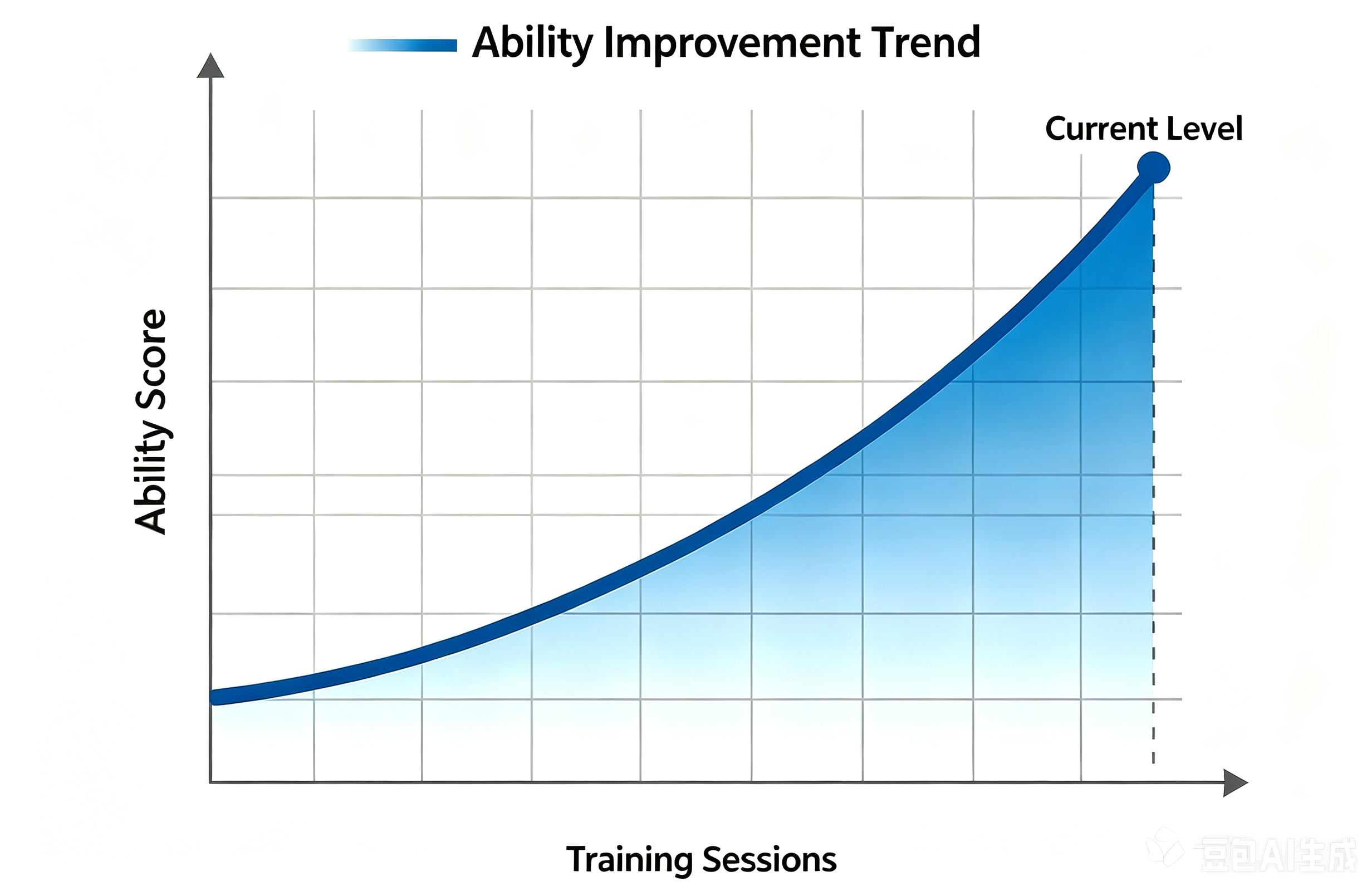
As the number of training sessions increases, trainees' skill levels steadily improve.
Diverse Application Scenarios
With flexible deployment, the system is suitable for three main scenarios: clinical skills centers in medical schools, obstetrics training centers in hospitals, and continuing education in primary healthcare institutions. It builds a comprehensive training system covering the entire career span from medical students to senior healthcare professionals.
Medical School Education
Serves as a pre-clinical practicum training tool, helping medical students master the identification and management protocols for obstetric emergencies before interacting with real patients, thereby reducing their anxiety during their first clinical practices. It supports the structured and rapid definition of flexible simulated case exams and mock test papers, helping medical trainees familiarize themselves with and enhance their clinical experience, while significantly improving team collaboration skills.
Pre-service and Refresher Training in Hospitals
Through simulated drills, medical trainees can enhance their overall surgical management and independent practice capabilities, as well as develop proficiency in handling obstetric emergencies, thereby reducing medical risks and the potential for disputes. Serving as an annual refresher platform for emergency skills, it fulfills the hospital's regulatory requirements for the regular training of medical and nursing staff.
Continuing Education and Remote Learning
Supports remote access, allowing medical trainees to utilize fragmented time for self-directed learning and skill enhancement. A continuous case library update mechanism ensures that training content remains synchronized with the latest clinical guidelines, promoting lifelong learning.
Comprehensive System Ecosystem and Backend Management
The system is equipped with a comprehensive software ecosystem and management tools. The client supports offline access and local data storage, while the backend management system enables cloud data storage, one-click import of mind-mapped cases, large-scale exam scheduling, and automated grading. Additionally, the official website provides online quizzes and resource downloads, building a complete end-to-end ecosystem from the terminal to the backend.
Client
Deeply optimized for Windows 10/11 with high-definition rendering. It supports offline access to the case library and local data storage to ensure data security in intranet environments, and is compatible with mainstream medical office devices.
Management Backend
Supports large-scale exam scheduling and an automated grading system. Cloud-based data storage synchronizes trainee scores across all hospital branches. Administrators can import newly organized mind-mapped cases with a single click, enabling continuous iteration of the case library.
System Official Website and Custom Tools
The platform provides online quizzes, certification issuance, and resource downloads. It supports remote access via VPN and fragmented learning. Its modular action definition allows for the flexible combination of 24 action nodes—including hand washing, draping, ultrasound, and issuing medical orders—theoretically enabling the creation of an infinite variety of training scenarios.
Core Value and Competitive Advantages of the System
Through digitalization, the Obstetrics Virtual Simulation Training System reconstructs the traditional training model, achieving breakthroughs across four key dimensions: safety assurance, standardized training, cost optimization, and data management.
Zero-Risk Safe Training
Allows trainees to repeatedly practice the management of rare and life-threatening conditions, such as amniotic fluid embolism and uterine rupture. This overcomes the limitations of scarce cases and high risks during clinical clerkships, preventing medical disputes or patient harm caused by operational errors.
Standardized Intelligent Scoring
Eliminates fluctuations in training quality caused by variations in instructor levels, ensuring that every trainee receives standardized skill training and objective competency assessments. The precise scoring mechanism helps cultivate rigorous clinical thinking.
Low Cost and High Return
Replaces high-fidelity mannequins and disposable medical consumables with a one-time investment that allows for unlimited reuse. This significantly reduces the burden of hardware maintenance and consumable procurement for training institutions, while supporting simultaneous training for large cohorts of trainees.
Full-Cycle Data Archives
Records the complete competency growth trajectory of trainees from medical students to senior healthcare professionals. It provides an objective basis for rapid training, skill drills, and performance assessments, establishing comprehensive learning archives and competency certifications.
Typical Cases and Successful Practices
The system has been successfully deployed and applied in top-tier medical institutions such as the Obstetrics and Gynecology Hospital of Fudan University and the Shenzhen Maternal and Child Healthcare Hospital. Serving as a core component of smart teaching, as well as a platform for pre-service and annual refresher training, practical testing has proven that it significantly enhances trainees' clinical decision-making abilities and teamwork skills, earning high recognition from both clinical instructors and trainees.

Obstetrics and Gynecology Hospital of Fudan University
Leveraging the hospital's profound clinical foundation, the system serves as a core component of smart teaching and has taken the lead in supporting multidisciplinary team (MDT) collaborative training for two critical conditions: postpartum hemorrhage and eclampsia. Following a 12-week practical test, trainees' decision-making response time improved by 65%.

Shenzhen Maternal and Child Healthcare Hospital
Serving as the pre-service admission assessment and annual emergency skills refresher platform for newly hired healthcare professionals, the system fulfills the hospital's regulatory requirements for regular staff training mandated by hospital accreditation. It effectively reduces medical risks and the potential for disputes.
Contact us
Looking forward to partnering with you to jointly enhance the rescue capabilities for critical obstetric emergencies.
We are not merely selling software; we are building an 'always-on clinical training ground' for every healthcare professional.
Leveraging the profound clinical foundation of the Obstetrics and Gynecology Hospital of Fudan University, and integrating cutting-edge Mixed Reality (MR) and 3D simulation technologies, we are building a globally leading obstetric emergency training base.